Nicolas Flamel’s house, circa 1407, is the oldest standing building in Paris. Image credit: hermetism.free.fr
The modest medieval house located at 51, Rue de Montmorency in Paris is off-radar for most tourists. Yet for a niche set of visitors with interests in alchemy and the occult, Harry Potter fans, or both, the building holds special mystique and allure.
This isn’t only because it happens to be (by some accounts) the oldest house in Paris. It also has legendary associations: Nicolas Flamel, the world’s most famous alleged alchemist, built the house in approximately 1407 (although, contrary to popular belief, he never actually lived there).
The house has been the subject of much lore centered around the wealthy Frenchman: he is said to have cracked the mysteries of the Philosopher’s Stone, and succeeded in turning metals into gold, within its heavy stone walls.
Nicolas Flamel as Philosopher and Alchemist, circa 19th century. Line engraving. Credit: Wellcome Library, London.
The legend of Nicolas Flamel is so pervasive and intriguing that J.K. Rowling featured him as a prominent eponymous character in Harry Potter and the Sorcerer’s Stone.
Since the release of the bestselling book and blockbuster film, pilgrimages to the house have predictably become far more frequent, including among young visitors. As this goes to press, Rowling’s fictional Flamel is next set to appear in Fantastic Beasts 2, a parallel Potter film franchise.
Not to disappoint those of you hoping to visit the home of a genuine alchemist, but historians are pretty much unanimous in their verdict that there’s no evidence for Flamel participating in such activities.
A scribe, notary public and bookseller who survived the Black Death and was noted by 15th-century Parisian society for his charitable and philanthropic activities, Flamel was, by all counts, a devout Christian.
While this doesn’t exclude him from dabbling in occult activities like alchemy, there’s nothing in the historical record to firmly tie him to these practices.
After the death of his wife Pernelle (who also appears as a character in Rowling’s aforementioned book) in 1397, Flamel came into a significant fortune; he used much of his newly acquired wealth to build almshouses for the poor. The stone house that stands on rue de Montmorency is the oldest of these to remain intact.
The Alchemical Legend: Origins
An image from the 1612 treatise “The Hieroglyphics of Nicolas Flamel”.
So where did the legend of the gentilhomme bourgeois‘ alchemical prowess come from? During the 15th and 16th centuries, interest in the occult, and particularly in alchemy, flourished as advances in science and chemistry opened new imaginative arenas.
Wealthy middle-class men were often rumored to have been powerful alchemists whose fortune arose from gold they miraculously forged themselves, and Nicolas Flamel was among them as a Parisian of note from centuries past.
His posthumous re-imagining as France’s most successful alchemist first came in a 15th-century manuscript called Le Livre Flamel (The Flamel Book), which attributed authorship to the Parisian.
Other texts, poems and manuscripts with alchemical themes later credited him as the author, the most famous of which is a treatise appearing in a print book published in 1612, “The Hieroglyphics of Nicolas Flamel”.
The illustrated text presented itself as a translation of a text written in Latin by Flamel in the late 13th century, and presenting numerous alchemical principles and ideas.
Although the legend of Flamel turns out to be largely the stuff of lore and posthumous speculation, a visit to his house can still make for an interesting half-hour, especially for anyone interested in medieval history and architecture.
There’s now a restaurant located on the rez-de-chaussée (ground floor) at 51 Rue de Montmorency, which is reputed to serve decent enough but not especially memorable food. (Metro: Rambuteau)
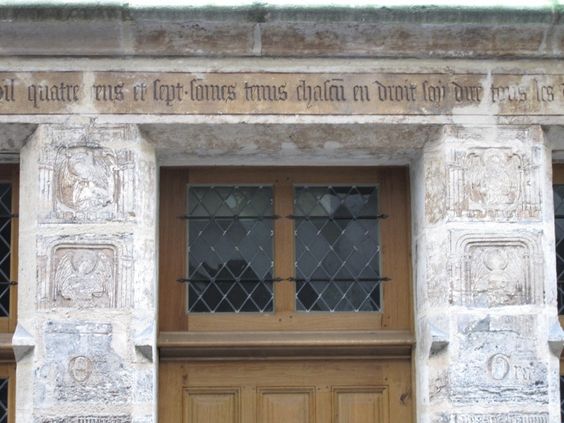
The ornate inscription scrawled above the door, which includes the date of construction and was fully restored by the city of Paris in 1900, reads the following in old French (my translation is just below):
“Nous homes et femes laboureurs demourans ou porche de ceste maison qui fu fte en lan de grace mil quatre cens et sept, somes tenus chacun en droit soy dire tous les jours une patrenostre et 1 ave maria en priant dieu que sa grace face pardon aux povres pescheurs trespassez. amen.”
“We men and women labourers residing in the entryway of this house, which was built in the year 1407, vow to recite each day Our Father who Art in Heaven and Ave Maria, praying to God by whose grace accords pardon to those poor sinners (who) trespass. Amen.”
The inscription above the door at Flamel’s house, flanked by musician angels. Image credit: Pariszigzag.fr
The deeply religious and devotional quality of the inscription is reinforced by etchings in the stone pillars surrounding the door: these depict four musician-angels playing harps and lutes, symbolizing the harmony and joy that await in heaven for those who have found redemption in Christ.
For anyone interested in learning more about Flamel or his legacy, be sure to also pay a visit to the Musée de Cluny, where his 15th-century tombstone can be viewed.
While the historical reality of this interesting figure doesn’t quite accord with the legend and pseudo-medievalist cottage industry built around him, visiting these sites in the capital will plunge you into a medieval Paris that is arguably just as fascinating- if not more so.
Courtney Traub is the Founder and Editor of Paris Unlocked. She’s a longtime Paris resident who now divides her time (as well as she can manage) between the French capital and Norwich, UK. Co-author of the 2012 Michelin Green Guide to Northern France & the Paris Region, she has been interviewed as an expert on Paris and France by the BBC, Australian Broadcasting Corporation, Le Figaro, Matador Network and other publications. Courtney has also written and reported stories for media outlets including Radio France Internationale, The Christian Science Monitor, Women’s Wear Daily and The Associated Press. In addition to going down various rabbit holes of curiosity when it comes to French culture, history, food and art, Courtney is a scholar of literature and cultural history whose essays and reviews have appeared in various forums.
One thought on ““Alchemist” Nicolas Flamel Built the Oldest House in Paris”
I lived in Paris in the 1950’s. I always felt at home there, I had Relatives there, that I did not know about until many years later. through years of research. I really do LOVE PARIS all year long. Spring Summer Winter Fall. I am so very happy that I found this Web site, Love it!!! I will be back!




I lived in Paris in the 1950’s. I always felt at home there, I had Relatives there, that I did not know about until many years later. through years of research. I really do LOVE PARIS all year long. Spring Summer Winter Fall. I am so very happy that I found this Web site, Love it!!! I will be back!